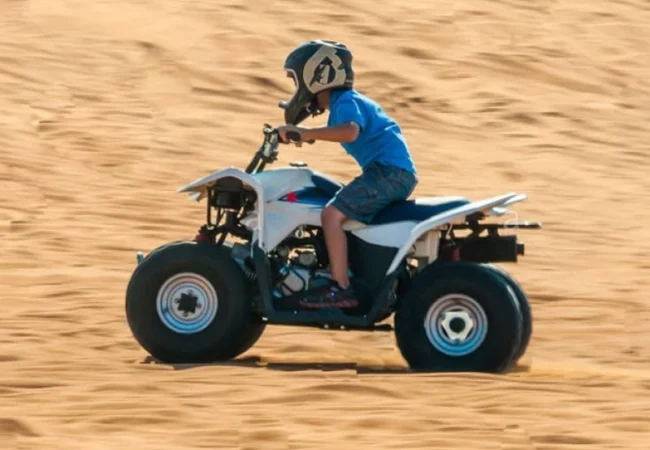
 AED 150
Yamaha 90cc
- Ages 9-12
- Track
- Supervised
Stays on its own marked loop right beside base, so a family splits naturally — kids circling here while the adults head out on a full route.
Book this ATV
This page runs two fleets side by side: eight Yamaha ATVs you ride solo with a throttle under your thumb, and a line of caged, wheel-steered dune buggies for anyone who would rather sit behind a harness than lean into a turn. Both leave from the same Al Lahbab base behind the same guides, so which one to book usually comes down to what you want in your hands.
Two machine racks sit side by side at Al Lahbab, roughly 45 minutes past Downtown on the red dunes. Adults working through the ATV rack start on the 220cc at AED 200, move up to the 400cc most people settle on at AED 250, or graduate to the Raptor 700cc at AED 795 once a guide waves them through — while a separate, supervised 90cc track lets nine-to-twelve-year-olds ride on their own for AED 150. A short walk away, the buggy line starts at AED 599 for a two-seat Polaris RZR and tops out near AED 1,400 for a four-seat turbocharged Can-Am.
Still torn between the two? The Evening Desert Safari with ATV and BBQ, AED 375, outsells everything else on this site and quietly removes the choice altogether — a Land Cruiser and its driver take care of the dune bashing, you still climb onto your own ATV for your leg of the evening, and everyone regroups at the BBQ camp once the sun's down. Secure online advance payment confirms your booking, support available 24/7.
Every ATV is priced per rider, since each seat needs its own booking — the 400cc double is the one exception, built for two people sharing a single seat and a single fee. Nothing gets charged until the machine, timing and pickup are all locked in. Buggy rates run on a different logic entirely, covered further down this page.
| Machine | Suits | From |
|---|---|---|
| Yamaha 90cc | Ages nine to twelve only, riding its own supervised loop with a guardian close by the whole time. | AED 150 |
| Yamaha 220cc | Zero experience needed. Light in the hand and genuinely hard to get into trouble on. | AED 200 |
| Yamaha 400cc | What the guided route is built around, and where most adult bookings land. | AED 250 |
| Yamaha 400cc double | One seat, two riders, one invoice — for a pair who would rather share than split up. | AED 350 |
| Yamaha 400cc turbo | The same frame with real pull added. Booked mostly by people repeating the standard 400cc. | AED 350 |
| Yamaha Grizzly 450cc | Extra weight over the front end for stability once a route runs long. | AED 450 |
| Sports quad 625cc | Quick to respond and unforgiving of a lazy riding position. For hours already logged elsewhere. | AED 700 |
| Yamaha Raptor 700cc | Top of the ATV rack, handed over only once a guide has watched you ride. | AED 795 |
Every ATV tour runs behind a guide, so the specific machine changes the challenge more than the risk. Sit on the one that will let you relax, and the route gets built to suit whatever you picked.
AED 150Stays on its own marked loop right beside base, so a family splits naturally — kids circling here while the adults head out on a full route.
Book this ATV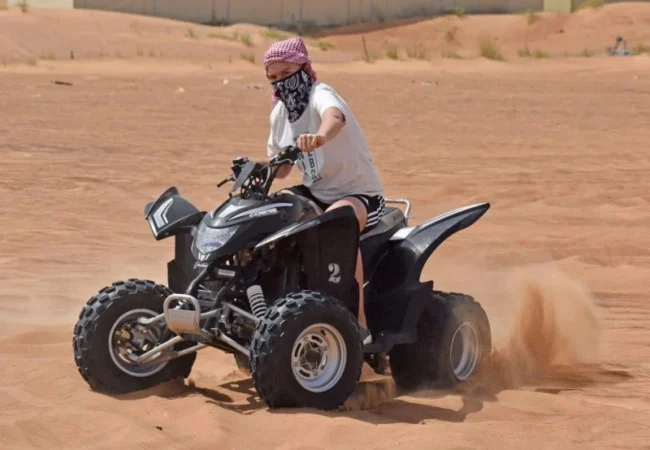 AED 200
Built to make a nervous first-timer forget to be nervous. Riders usually walk away wishing they'd blocked out longer, not chosen anything bigger.
Book this ATV AED 250
The one the standard route is designed around. It carries you through without asking much back, which is the entire appeal.
Book this ATV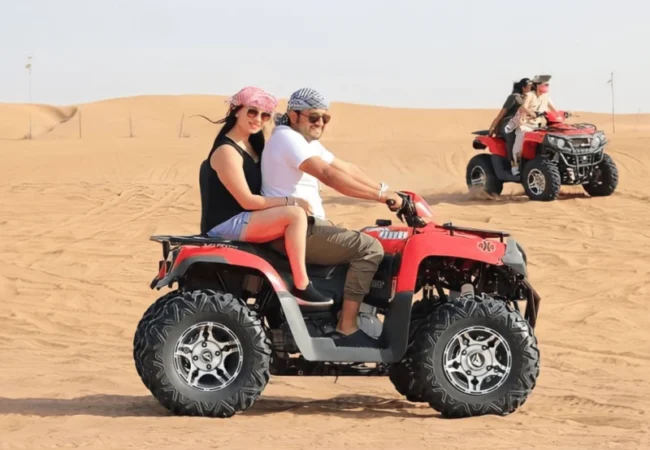 AED 350
Built for the pair where one of you actually wants the controls and the other is happy to just hang on for the ride.
Book this ATV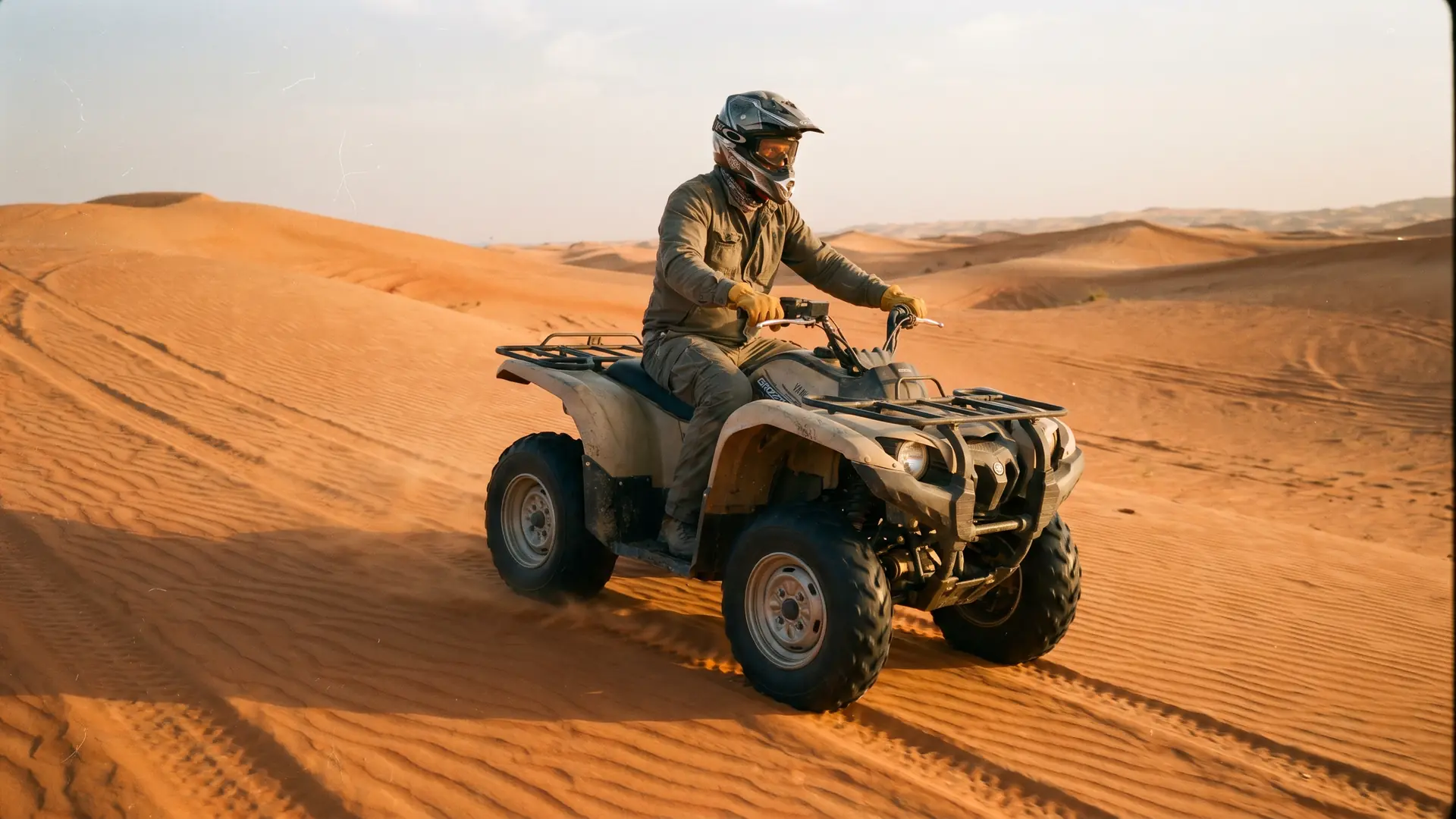 AED 350
Same seating position as the standard 400cc, with noticeably more shove out of a bowl. Mostly booked by repeat riders.
Book this ATV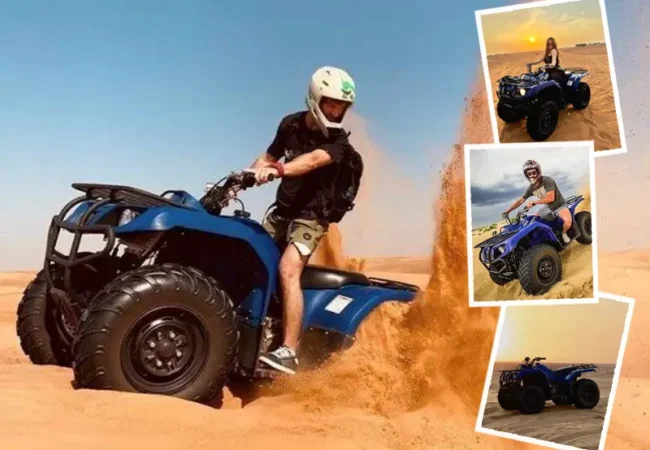 AED 450
Extra weight sits low and keeps it planted over broken ground. Ask for this one on the longer routes rather than the standard loop.
Book this ATV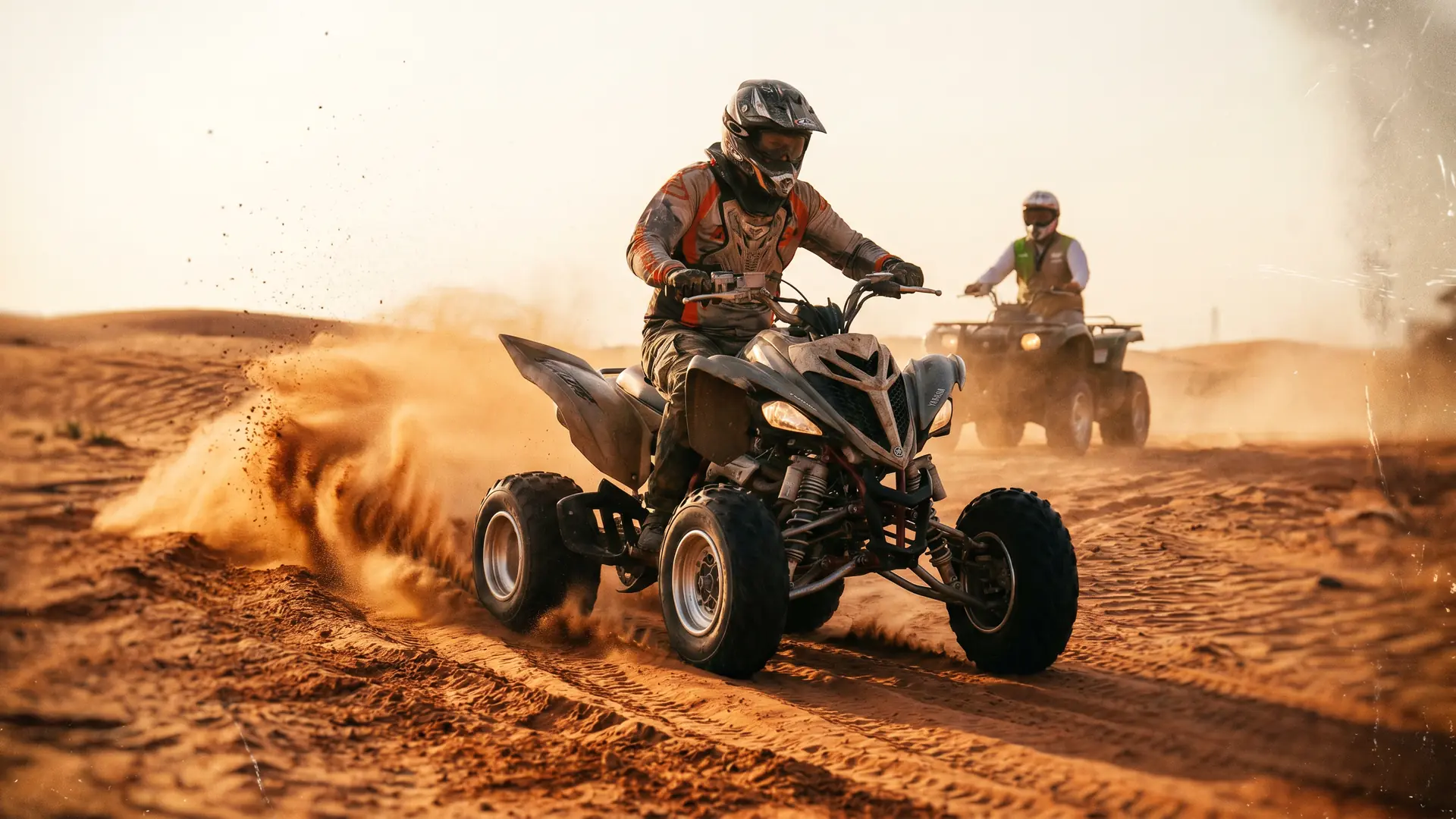 AED 700
Punishes a rider who stays seated and hopes. Stand up, shift your weight, and it responds properly.
Book this ATV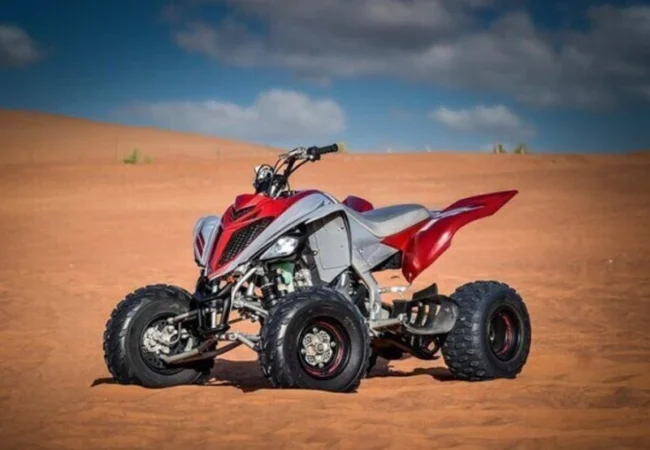 AED 795
Won't be released just because you asked for it — a guide will want to hear, honestly, what you've actually ridden before handing over the keys.
Book this ATVAn hour on the ATV bookends a 45-minute drive in each direction, so most riders turn it into more than a there-and-back trip. Add the safari and the BBQ camp and that drive earns its keep — which is exactly why these bundled tours sell better than a standalone ATV outing.
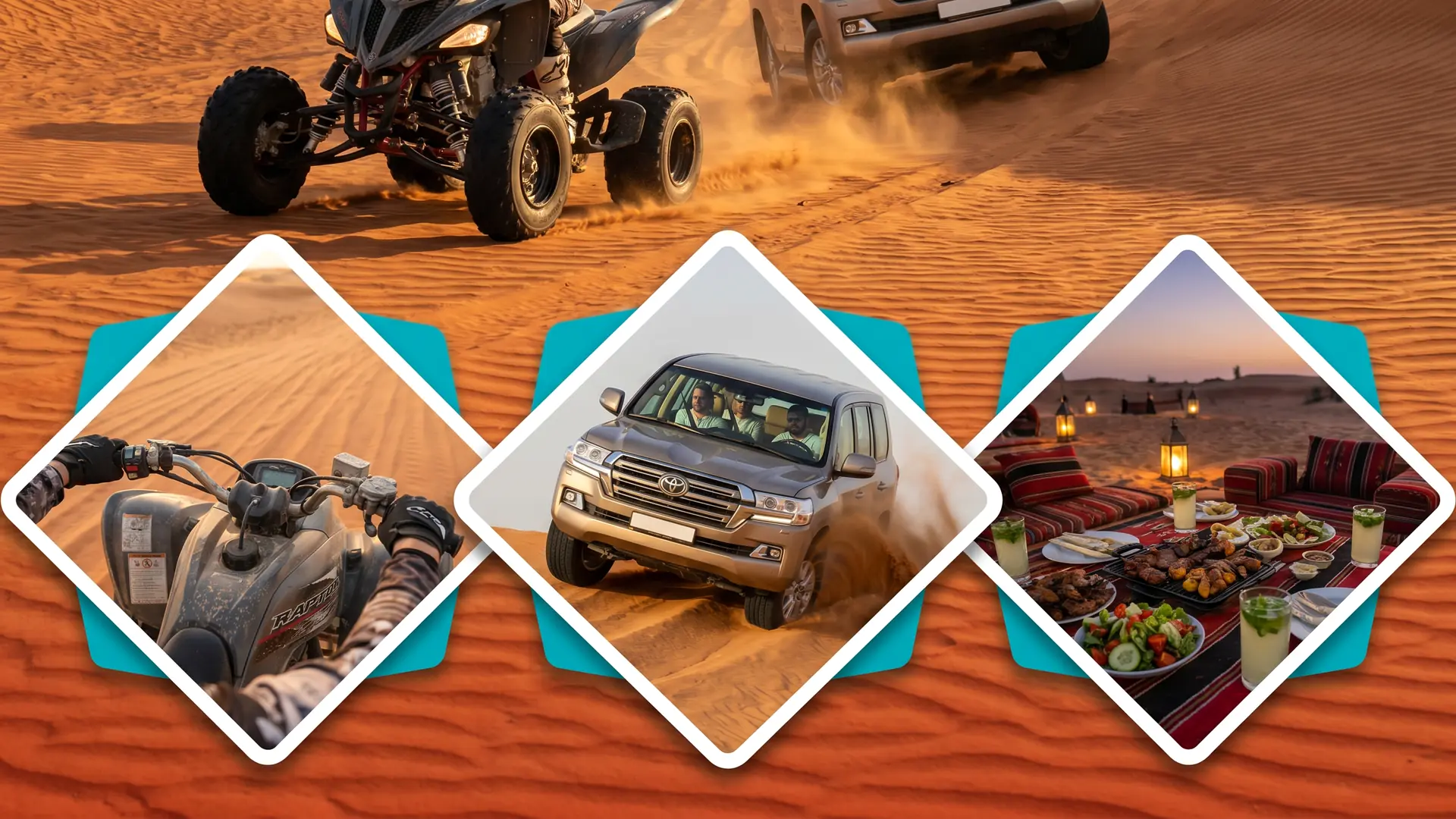 AED 375
A professional driver handles the dune bashing first, in a Land Cruiser, before you swap into your own ATV for the second half, with sunset over the ridges and a halal BBQ waiting at the end. Nothing else on this site sells more.
Book this tour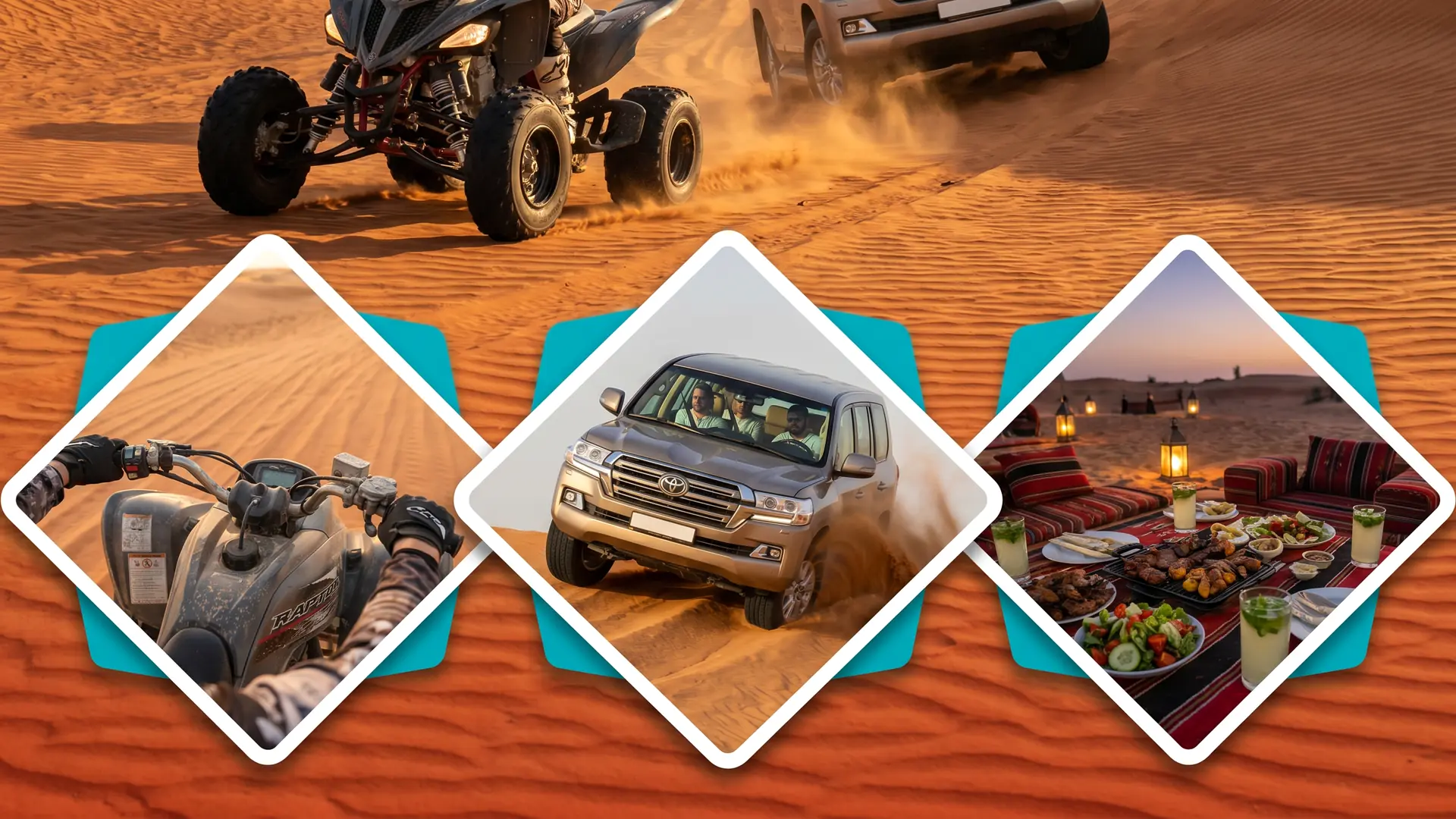 AED 290
Overnight cooling firms up the sand, which takes some of the sting out of the climbs for anyone new to riding. You'll be back in town with most of the day still unspent.
Book this tour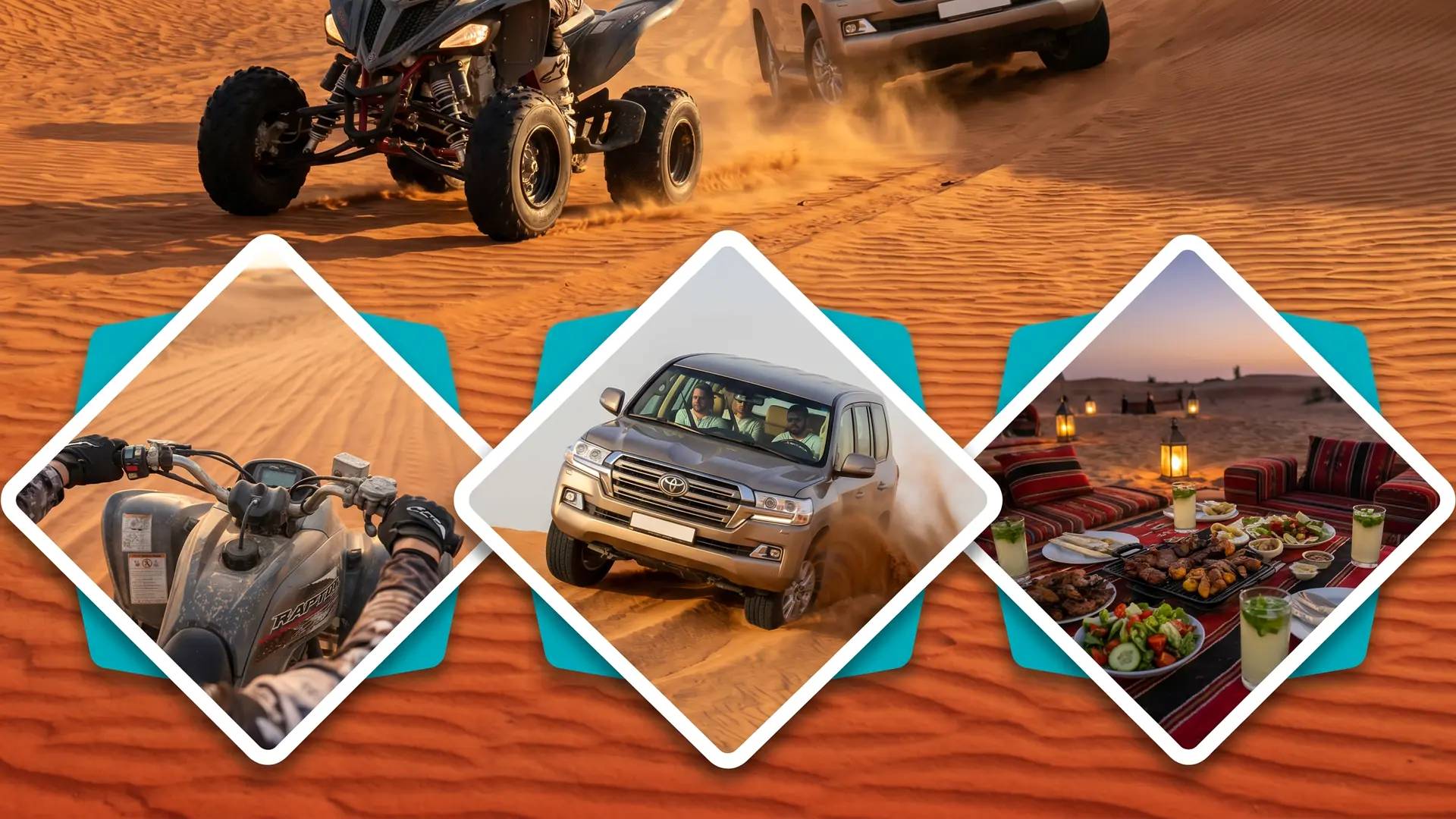 AED 700–1,300
Skips the 4x4 dune bashing entirely, for anyone who gets queasy being driven hard over sand. Keeps your ATV session and the camp dinner, with the final figure shifting depending on which machine ends up under you.
Book this tour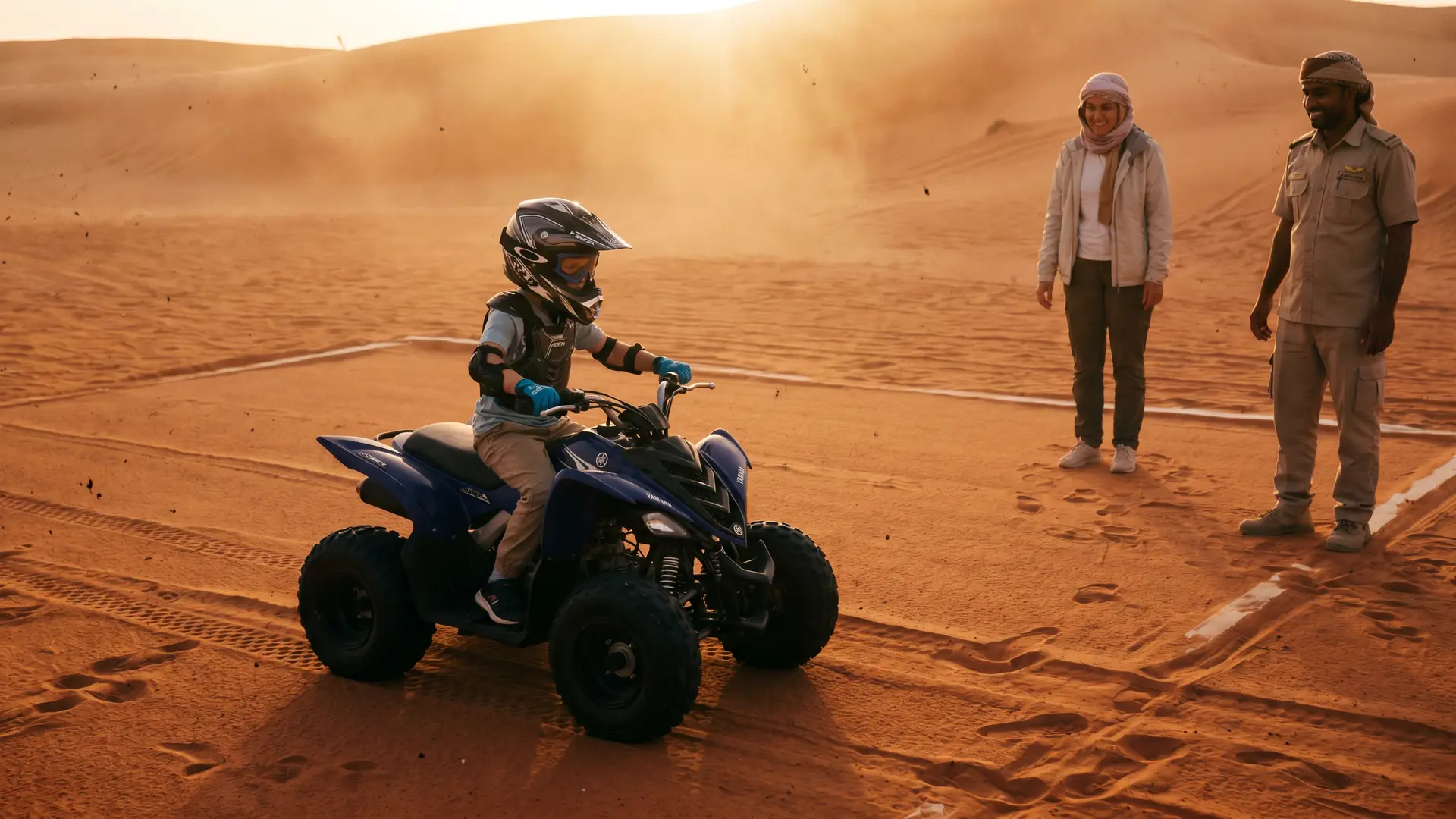 AED 150
Kids circle the supervised 90cc loop right where the adults set off on a full route — one base, one time slot, so nobody's stuck sitting in a parked car.
Book a family tourThis one is mostly about the ATV side — cars don't count, think motorbikes, jet skis, anything you've actually throttled with your right hand.
The drive shapes both fleets equally, and it's worth planning around before you pick a time slot.
Sit on top of an ATV and you steer it with your body; climb into a buggy and you steer it with a wheel while a cage and harness do the worrying for you. Which one wins isn't obvious, which is exactly why there's a full comparison guide below rather than a sales pitch here.
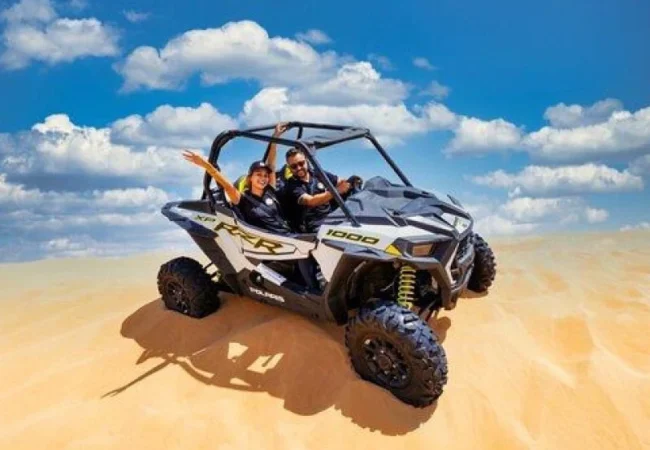
The easiest entry point into either fleet, ATV or buggy. Steady on a line, forgiving when you misjudge one, and usually the first machine a new buggy driver gets handed.
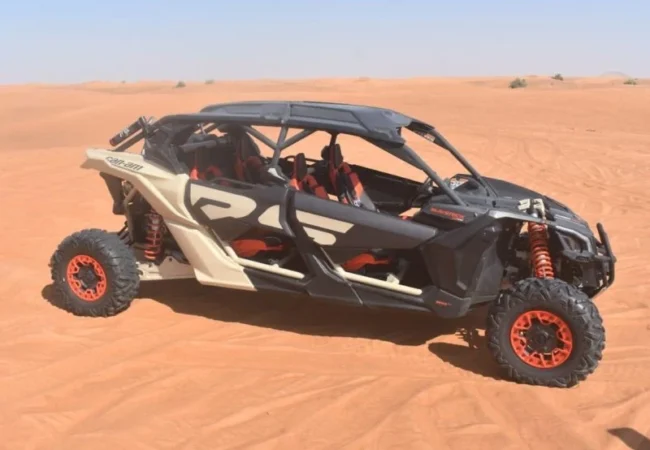
A wide-set chassis and long-travel suspension built to carry the whole group at once, billed as a single vehicle fee instead of four separate ATV bookings.
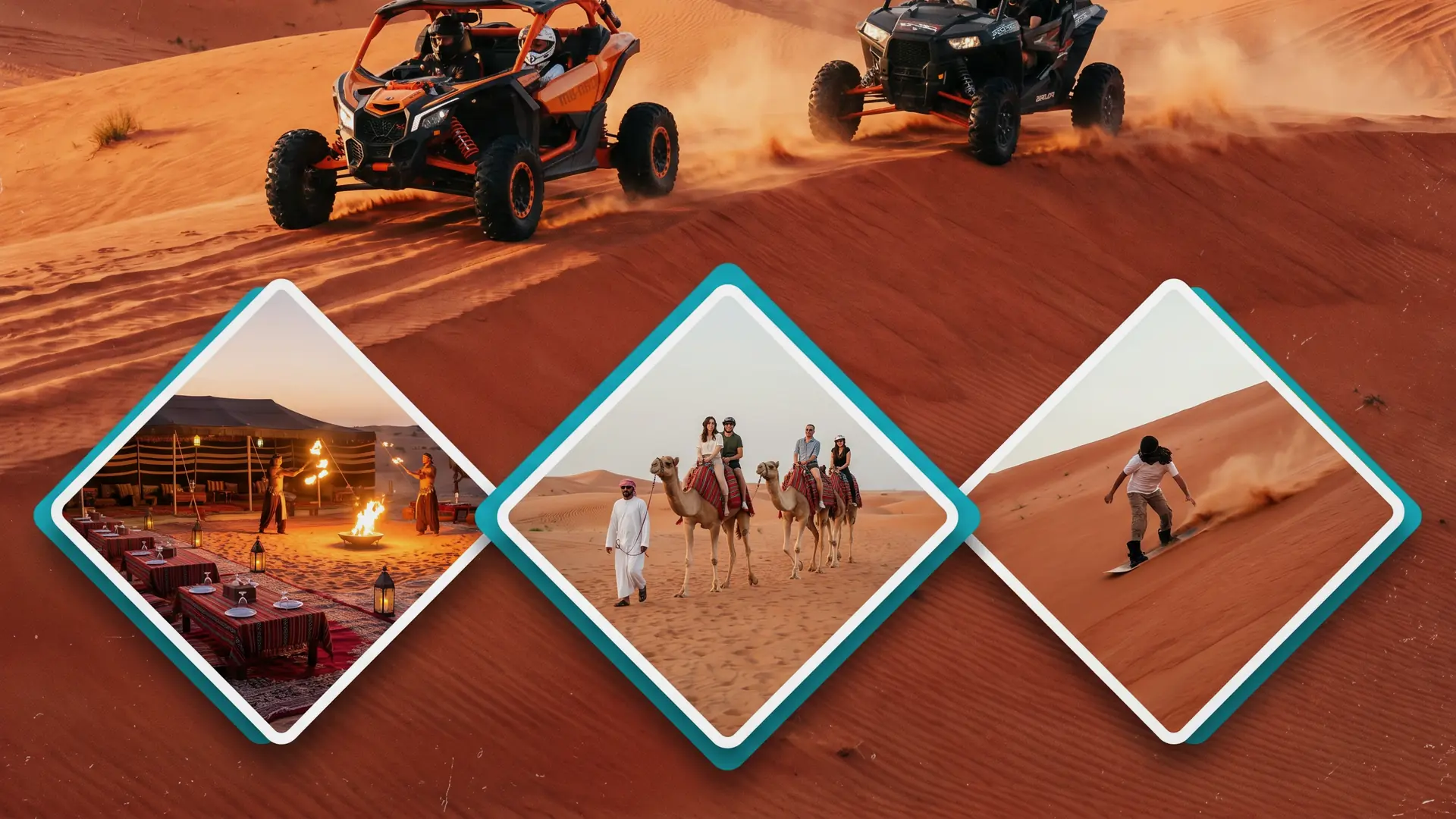
Still weighing it up after reading this far? Start on the ATV while your grip is fresh, then switch to the buggy's wheel for the back half of the session.
Two wheels get you no benefit of the doubt here — this booking starts with a few questions, not a straight yes. Soft sand exposes shaky technique on a bike in a way four wheels simply absorb, and unlike an ATV or a caged buggy, a KTM won't quietly correct your mistakes for you.
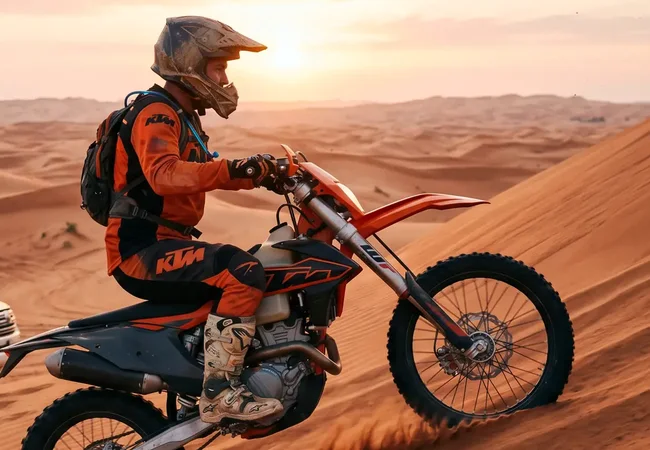
The first hour is AED 850, and it's AED 1,250 if you stay out for two. Come with a genuine off-road track record — enthusiasm on its own won't get you the keys here.
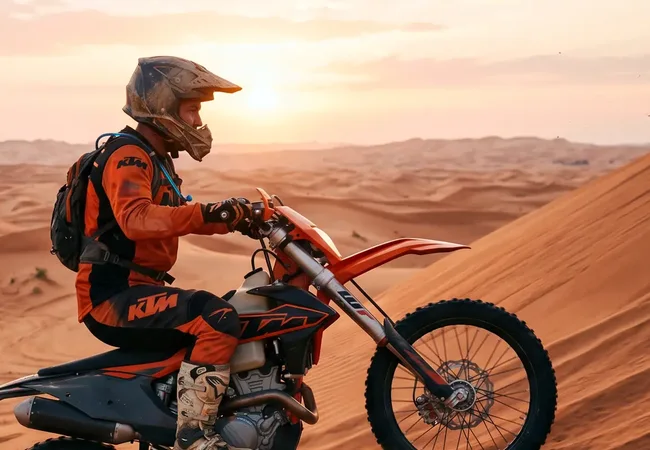
Reserved strictly for the advanced route, released only once a guide has actually watched you ride and signed off on it. There's no listed price for this one — you'll get a number once that check is done.
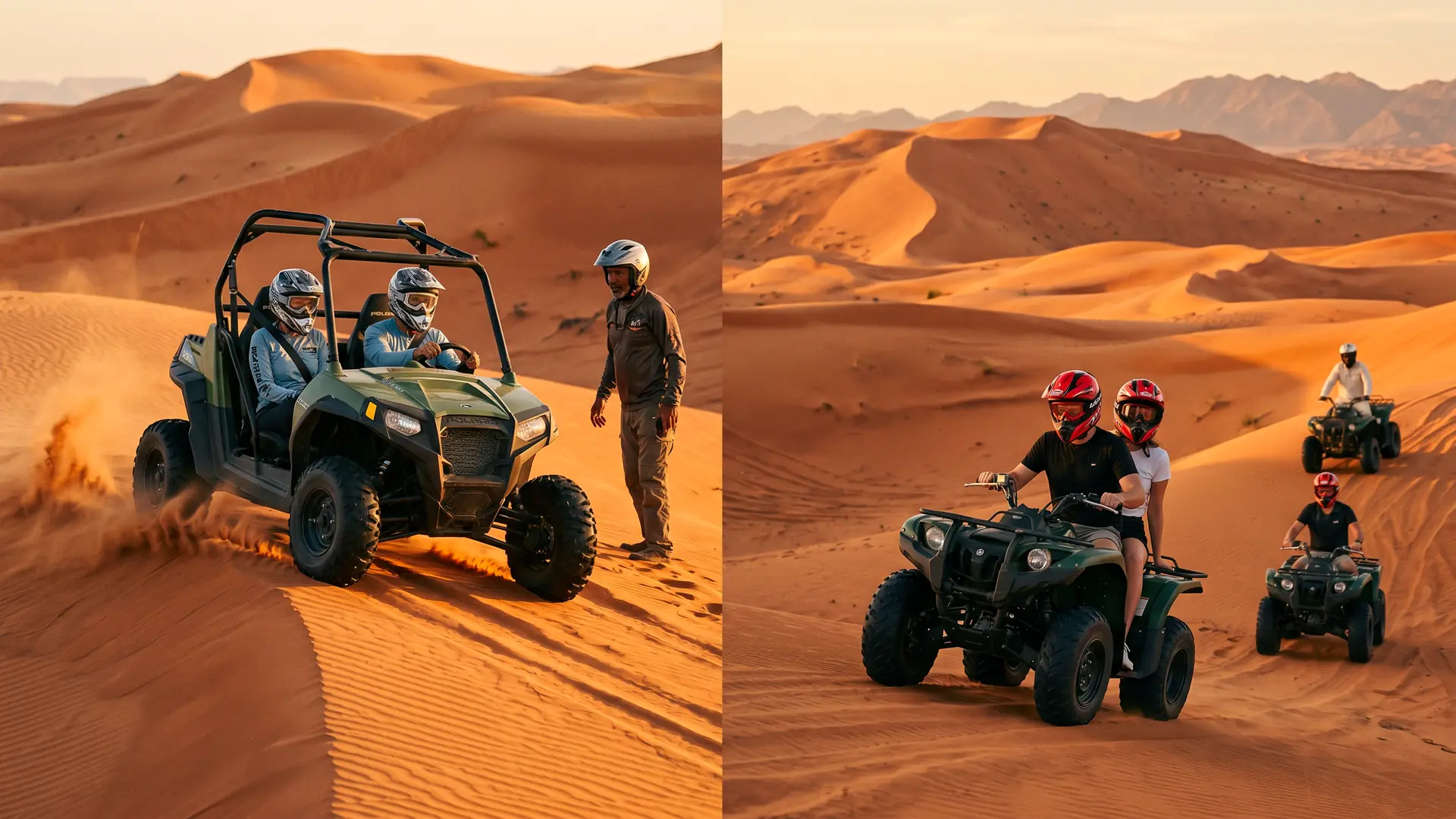
Not cleared for the KTM? The Raptor 700cc is right there as a stand-in — almost the same rush, minus the two extra wheels' worth of risk.
From AED 225, a professional driver takes the wheel of a Land Cruiser and handles the dune bashing for you. Mixed group riding ATVs, buggies, or neither? Most people visiting here end up adding one of these safaris on top regardless.
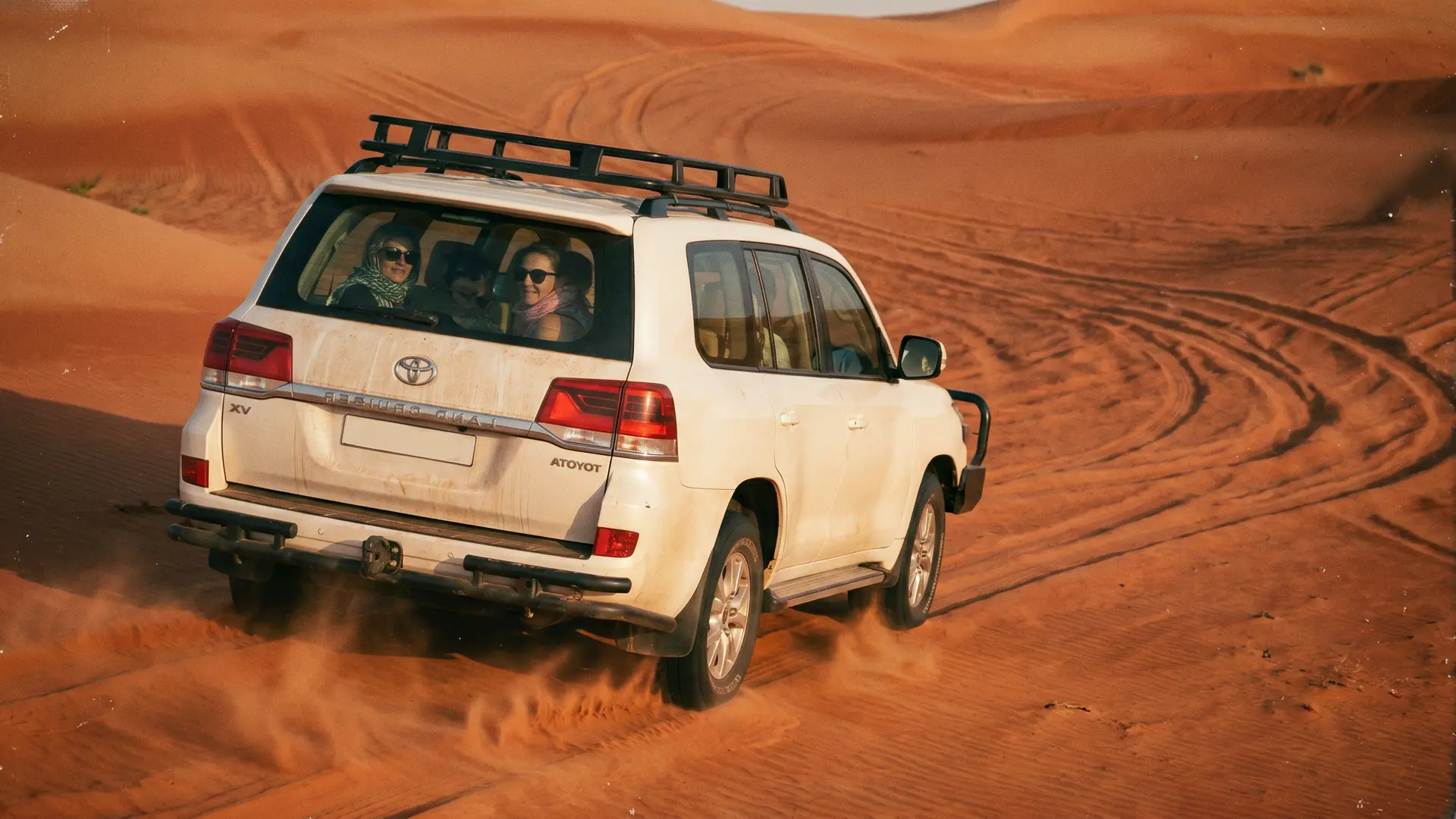
Sets off while the sand's still cool from overnight, and has you back among the city towers well before midday, with the rest of the day still yours.
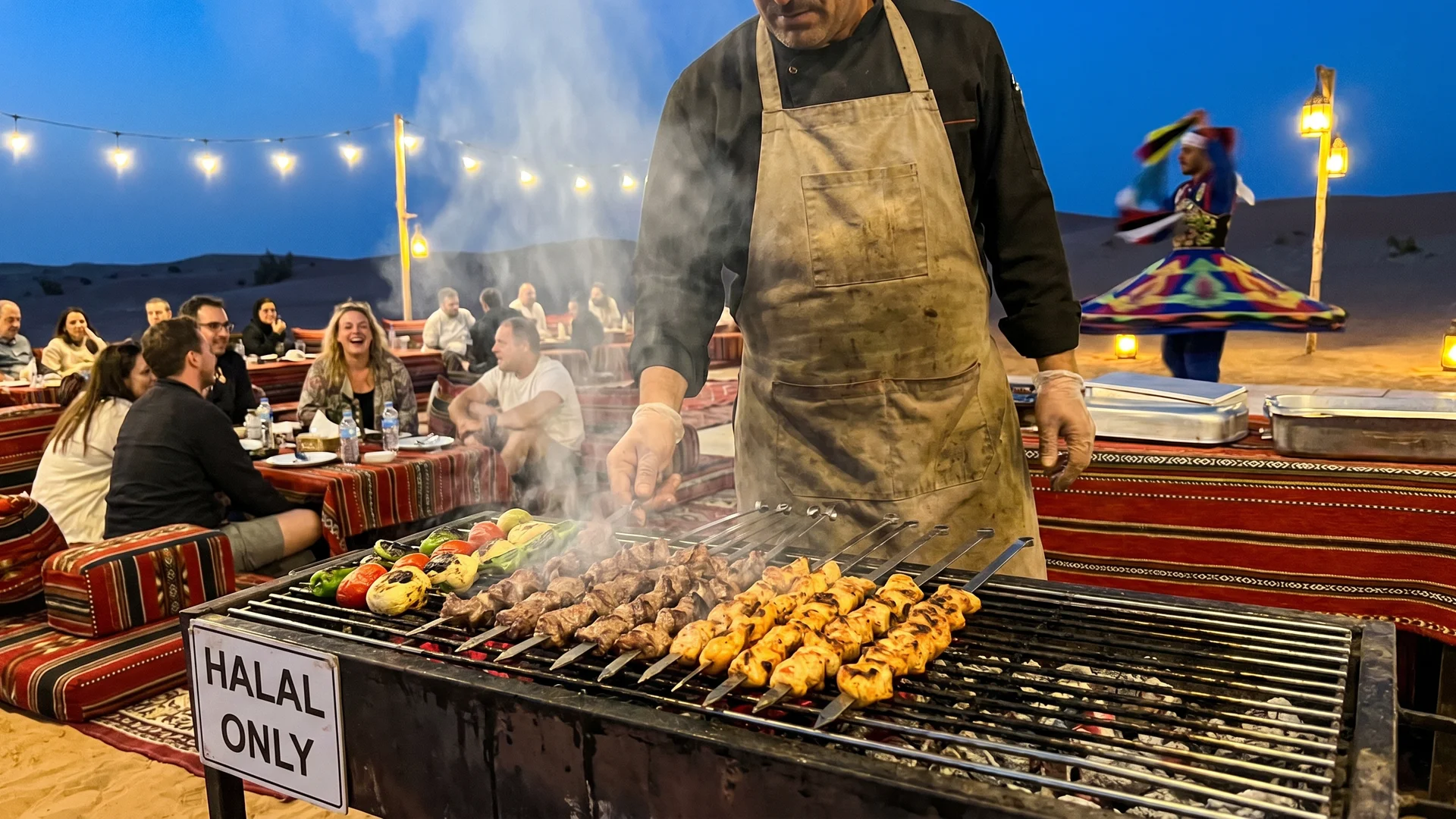
Dune bashing rolls into sunset over the ridges, then the camp and a halal BBQ dinner, with transfers sorted in both directions.
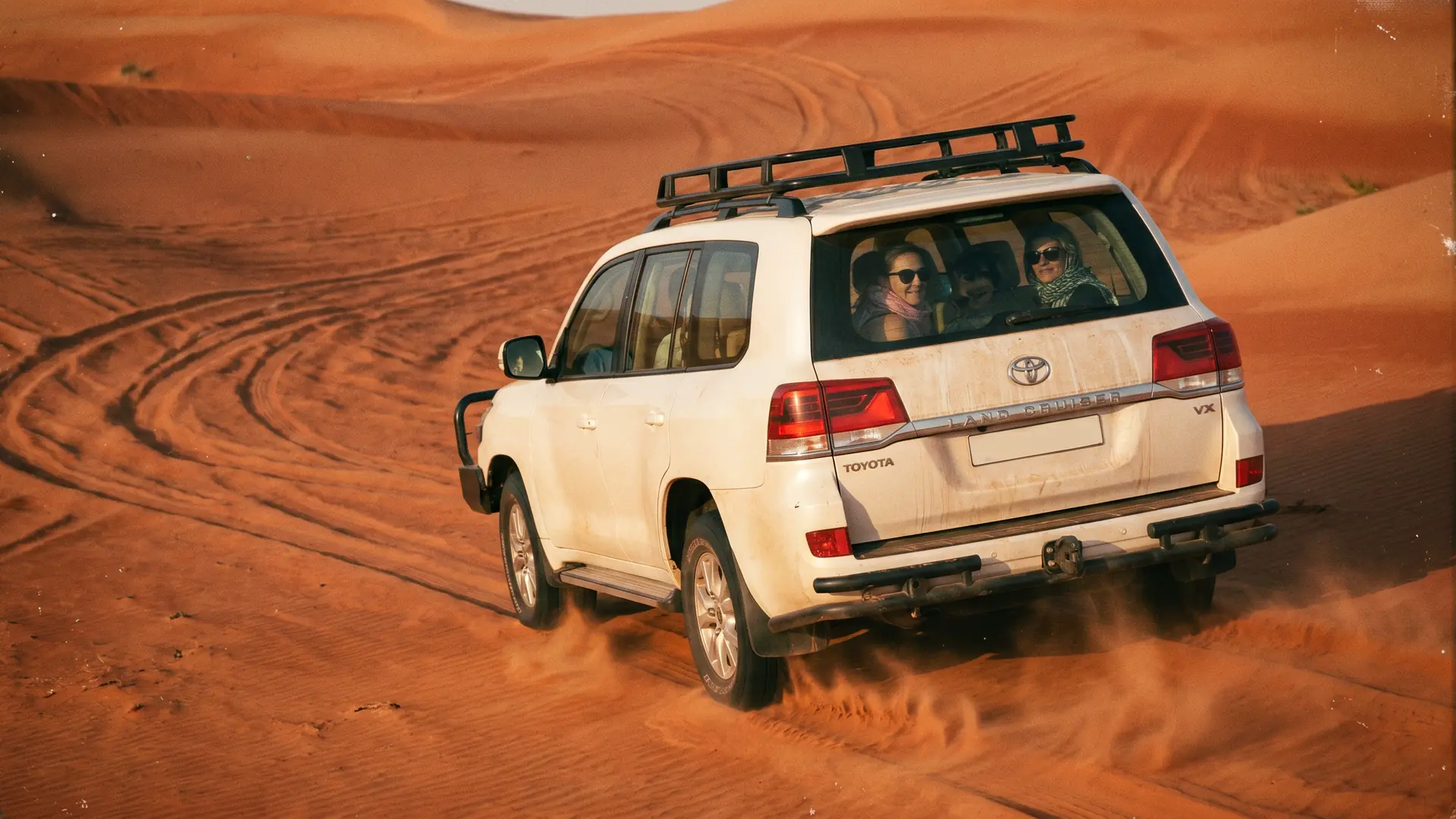
Your own vehicle and a reserved table at camp — nobody outside your booking joins the ride or the seating.
There's more beyond these three listed packages — private safaris run separately at AED 799 for a morning slot and AED 1,400 in the evening, plus overnight camping and corporate setups on request. If motion sickness is a concern, ask about a calmer route that keeps the dune bashing out of the itinerary.
Pickup happens around 4:30am, and you're back on solid ground before most hotels have even finished serving breakfast. Flights operate from September into May most years, and when it comes to folding for bad weather, nothing else on this page moves as fast as a balloon does.
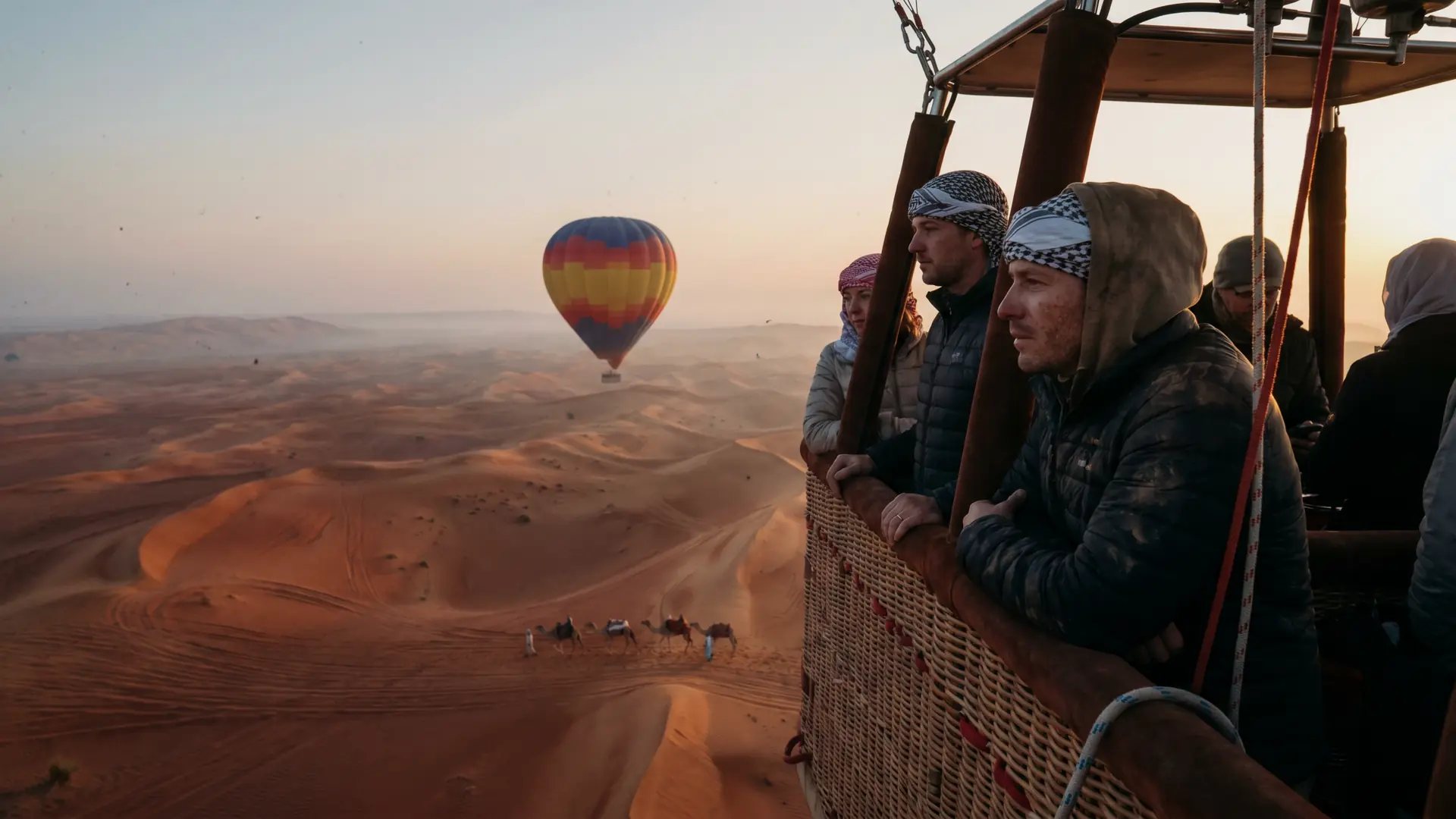
The standard flight starts at AED 1,049, AED 1,149 once falconry is added, or AED 1,349 with a full breakfast included.
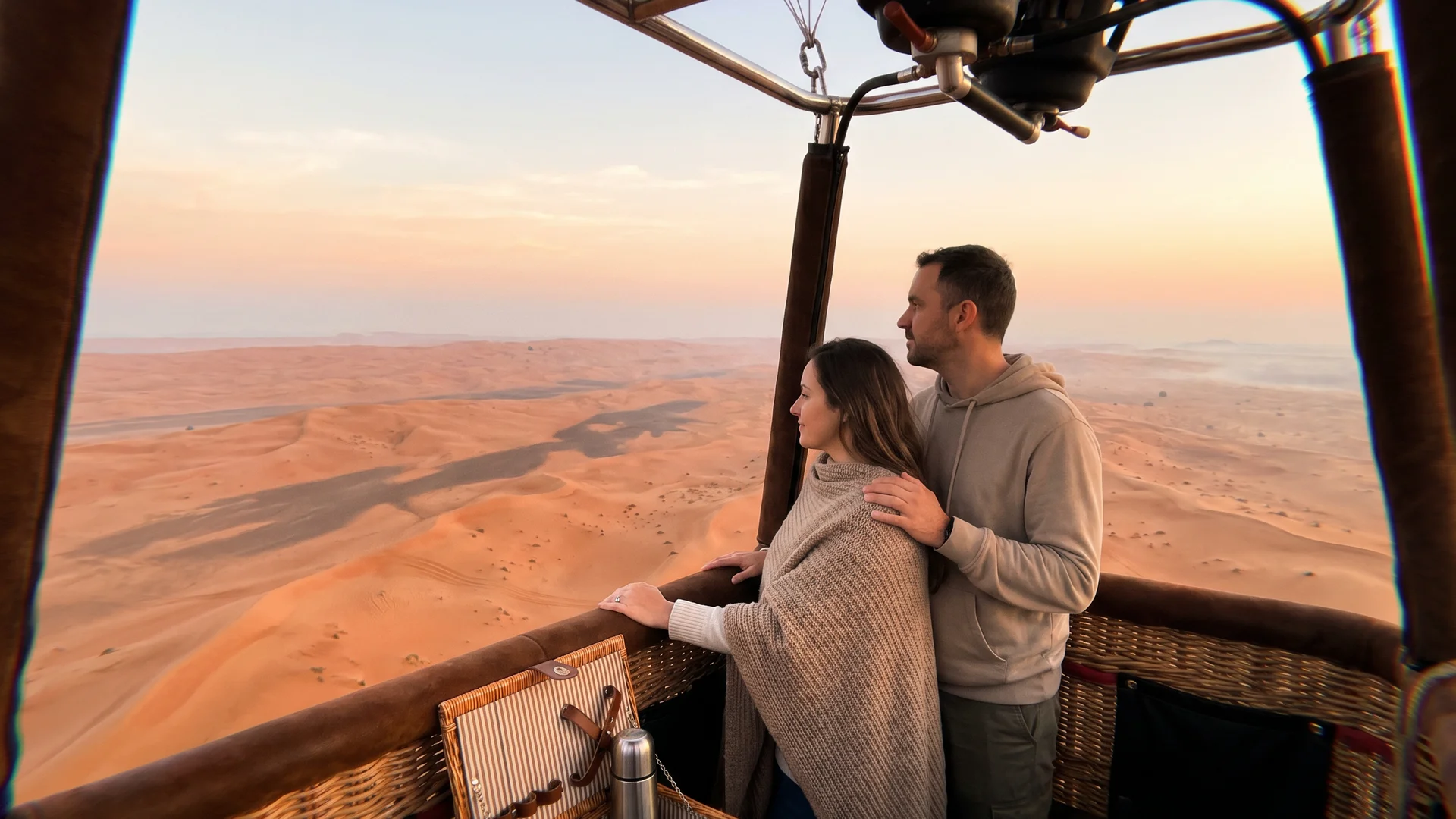
The entire basket reserved for your group alone, nobody else on board. A regular pick for proposals, anniversaries and corporate mornings.
A solid option to tack on for a young child, an older relative, or anyone who watched the ATVs and buggies roll out and decided both were a hard pass.
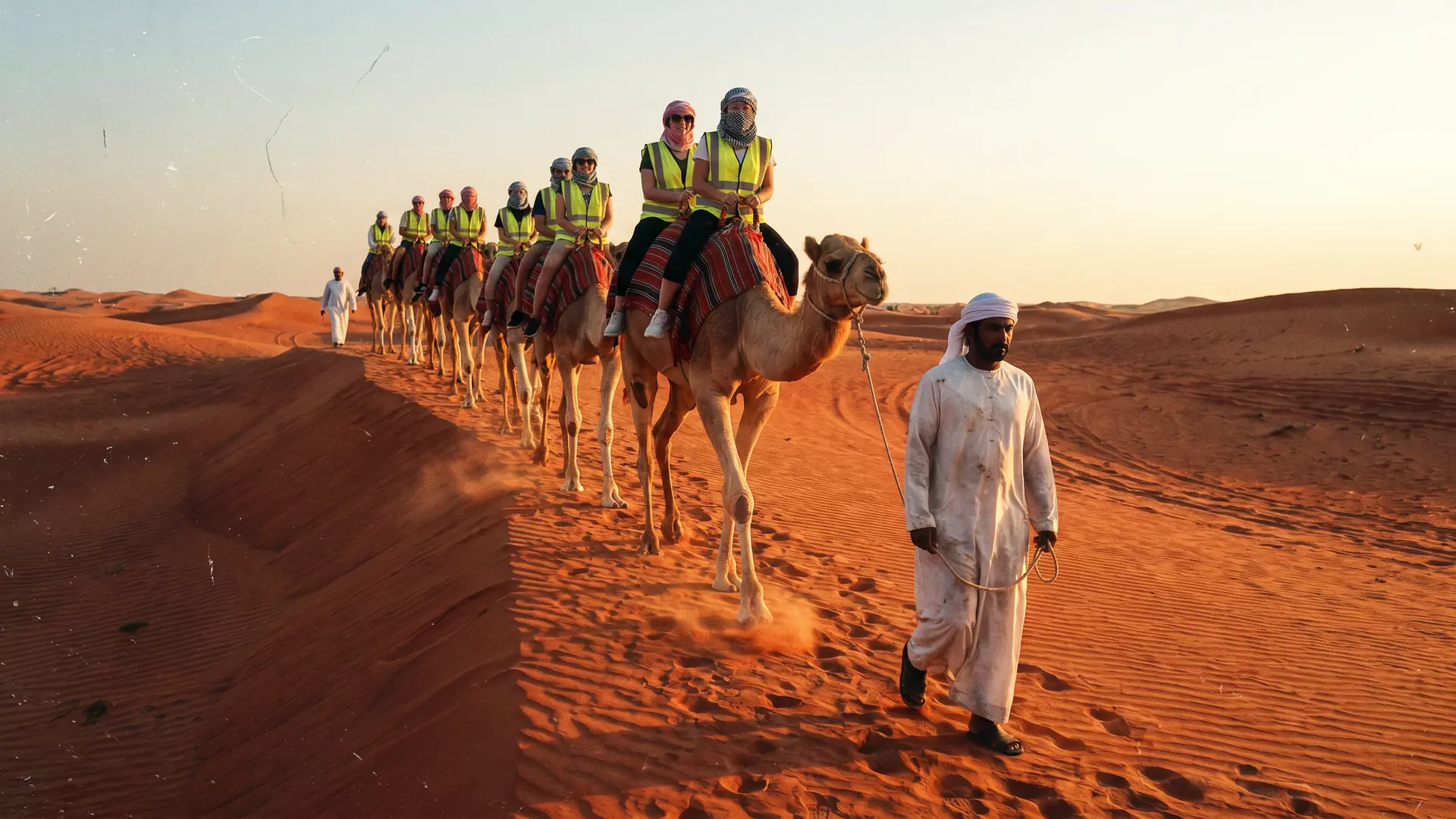
The same dunes the ATVs and buggies cross get covered on foot instead, guide leading the way, with riders welcome from age three provided a parent or guardian rides alongside.
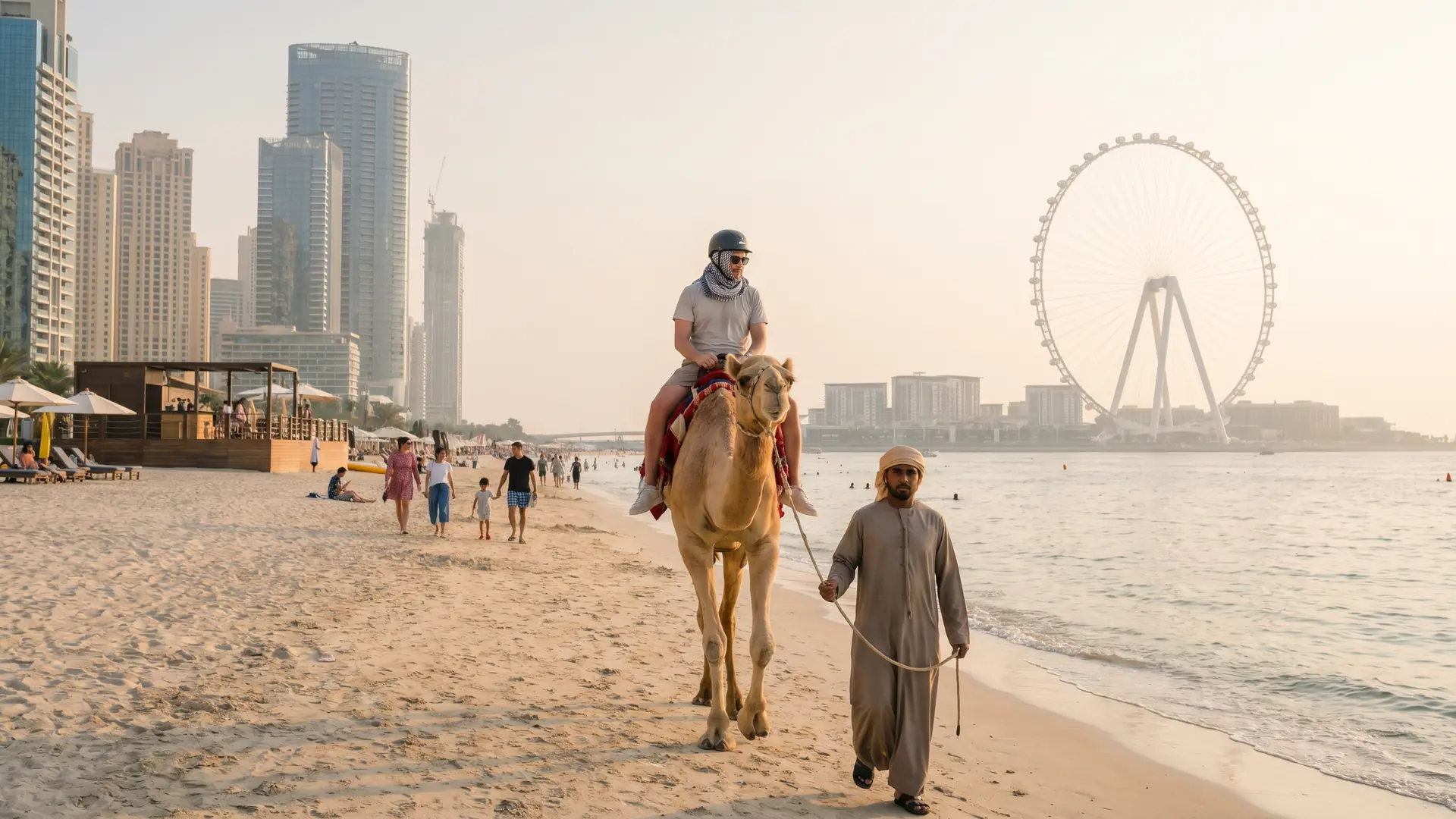
Skip the 45-minute drive out to Al Lahbab entirely — this one happens right on the JBR sand, and it's the photo op most visitors showed up for in the first place.
Already comfortable in a saddle? Guided desert horse rides are also available, starting at AED 575.
Pin down a number here and headcount, machine choice and how many hours you're blocking out all move it — there's no set menu. Message the details and you'll have a quote back the same day.
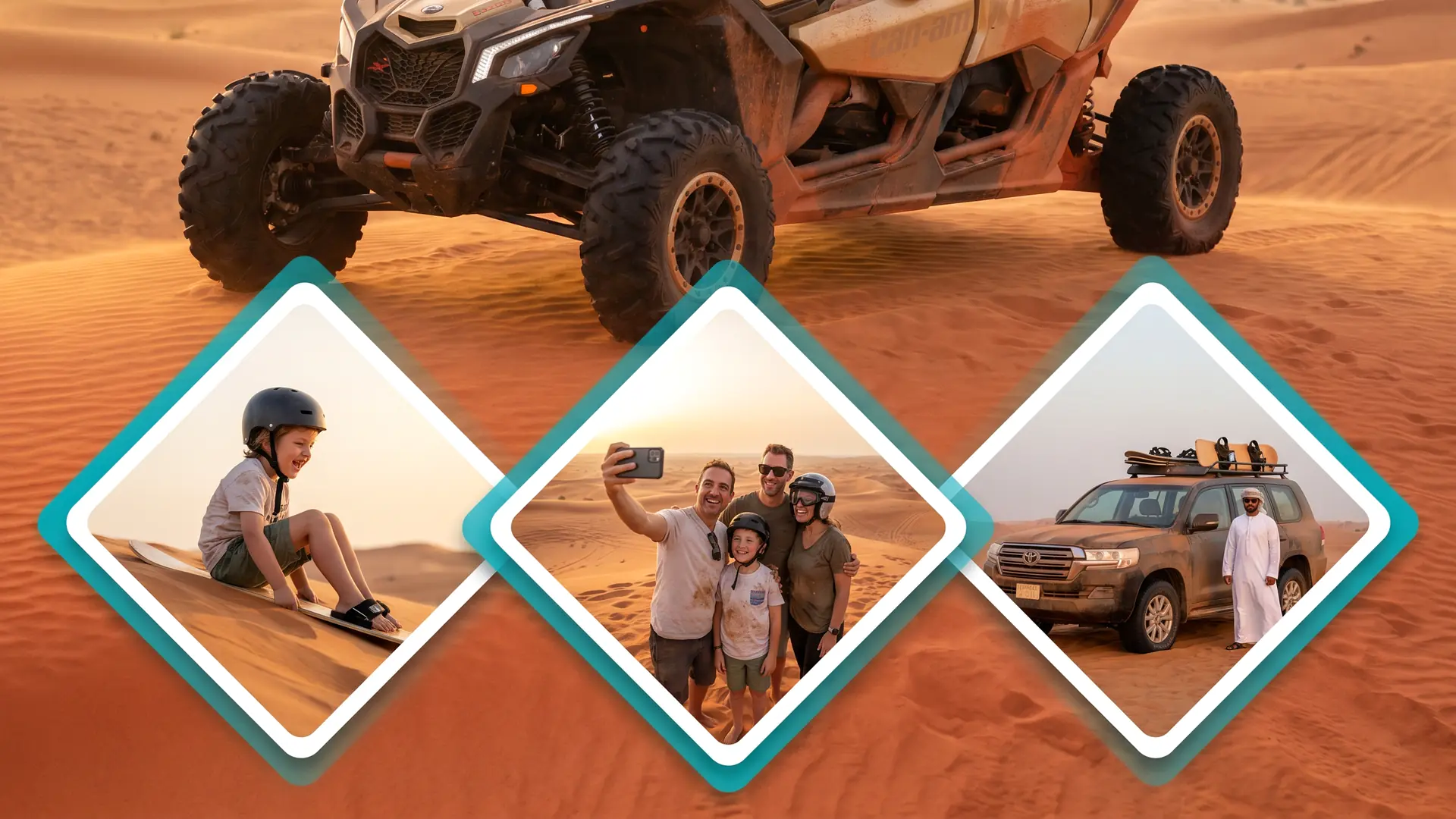
Combine every activity here — ATV, buggy, safari and BBQ — into one single booking, with the total typically landing somewhere between AED 700 and 2,200. Want the fully loaded version? Tack a sunrise balloon onto the very start of the day.
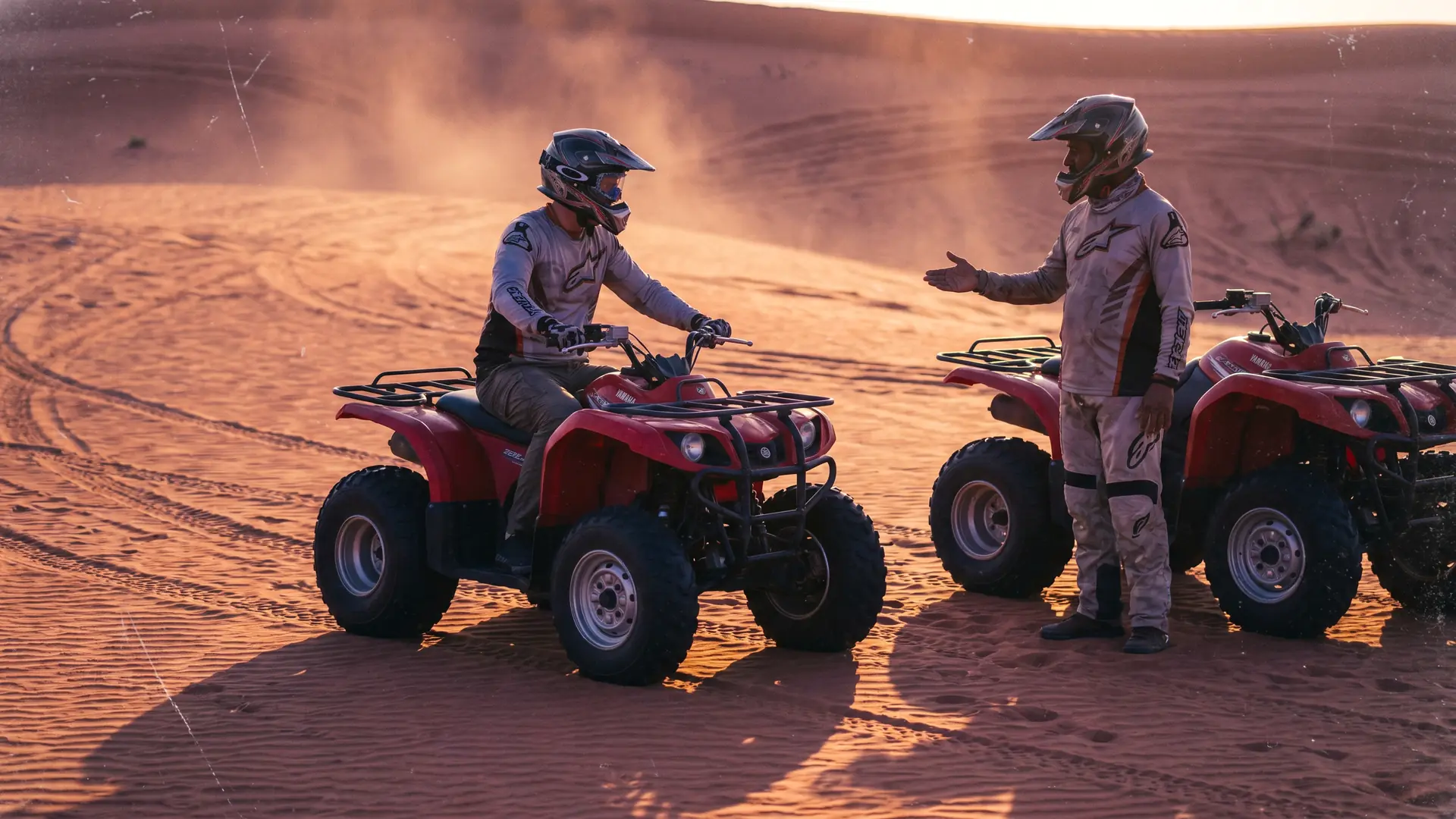
Twelve-plus in your party? Everyone gets sorted between ATVs and buggies based on who actually wants to drive, and the whole group moves through one guide-led schedule together.
Every ATV and buggy on this site rides out of one spot: Al Lahbab, tucked southeast of the city just off the Dubai–Al Ain road. That deep-red sand you see in the photos isn't a filter — it's the actual colour of the terrain, and the dunes behind it are real bowls and ridgelines rather than the smoothed-over mounds sitting closer to the highway.
Every session opens on flat, open ground back at base rather than straight onto a dune — that's where the warm-up happens. It's a small step that does most of the safety work here, because it's how your guide works out which route, and honestly which fleet, actually fits you.
Whichever machine you picked and however long you booked for, it plays out in the same six stages — the only thing that stretches or shrinks is the riding block in the middle.
Book from the city and you're collected directly; driving yourself gets you meeting-point directions as soon as the booking is confirmed.
Helmets and gear come first, then a walkthrough of the controls — throttle and brakes if you're on an ATV, wheel and pedals if you're in a buggy — plus whatever hand signal means "stop" out on the sand.
A handful of laps on flat sand first, so the guide can watch how you're getting on with your machine — whatever they see there is what sets your route.
Then it's out onto the dunes proper, following the lead vehicle through the bowls and ridgelines with photo stops built into the route along the way.
Back at base, there's a short breather to rehydrate and let your pulse settle while the day's photos are pulled together for you — from there it's either the drive back into town or straight on to whatever else is on your booking.
Dinner in the booking? From this point the whole group rolls onward to the halal BBQ camp together — one stop, whichever fleet got you here.
The supervised 90cc lane is where the nine-to-twelve bracket rides, guardian always close by. Anyone younger than that isn't left out — they can still climb into a buggy as a passenger, seated next to whichever adult has the wheel, or try a camel ride from age three instead. If you've got a borderline case in your group, mention it when you pay rather than waiting for the briefing — that gap gives everyone actual time to figure out the right fit. Dream Land Adventure Tourism holds the DTCM licence this operation runs under, and once you're out on the sand, the guide has the final word on the day.
Based on 758 Google reviews
Based on 1,193 reviews
ATVs are priced per rider — AED 150 covers the supervised kids' 90cc, AED 795 is the ceiling for the Raptor 700cc once you've been cleared for it, and the 400cc most adults end up on runs AED 250. Buggies flip to a per-vehicle price instead: AED 599 gets a two-seat Polaris RZR, rising to AED 1,400 for the four-seat turbocharged Can-Am. Combine either fleet with the Evening Desert Safari and BBQ and the two together come to AED 375.
Both are guided and both start with a warm-up, so neither is objectively harder to book. A buggy's steering wheel and pedals feel more familiar if you've only ever driven a car; an ATV's entry-level 220cc is deliberately light and forgiving if you don't mind standing and leaning instead. The full comparison, with all seven angles, is laid out in the guide further down this page.
Al Lahbab, off the Dubai-Al Ain highway on the city's southeastern edge — call it a 45-minute drive from Downtown. Both fleets ride the exact same red-sand terrain from the exact same base, which is part of why it makes sense to weigh them against each other rather than book blind.
Neither one needs a licence, since you're on private desert land rather than a public road. Zero experience is fine too — say so at the briefing and you'll be started on the ATV's 220cc or the easiest buggy in the fleet. What actually sets your route is the warm-up lap itself, not anything filled in ahead of time.
Guided, on both fleets. You're behind the controls of your own machine, but a lead guide sets the route, the spacing between vehicles and the stops. Nobody gets sent out alone, and the pace follows the least confident rider in the group rather than the fastest.
On the ATV side, ages nine to twelve can ride the supervised 90cc themselves, guardian included, at AED 150. On the buggy side there's no solo driving for minors, but a young child can ride along as a passenger next to a driving adult, which opens the buggy up to a wider age range in that sense. Camel rides welcome children from age three.
Pickup sits outside the base price — you'll see it quoted separately before paying, whichever fleet you're booking. The regular collection zones are JBR, Marina, Downtown, Business Bay and Deira. Prefer to drive yourself out? That's fine too, and you'll get directions as soon as the booking is confirmed.
Plan on losing most of a morning or afternoon to this once transport gets added in. On the sand, ATV and buggy sessions both run to the same standard-loop length, but the round trip from central Dubai adds close to 90 minutes on top of that. Most visitors respond by pairing the ride with a safari, or trying the second fleet as well, rather than treating that drive as worthwhile for a single quick session.
Closed-toe shoes matter most on the ATV, though they're still the smarter call in a buggy too. Bring sunglasses and clothes you're fine sacrificing to sand — helmets come included on both fleets. One small thing genuinely helps more than people expect: something to cover your nose and mouth once the wind picks up. Toss a fresh set of clothes in the car too, so the ride home isn't spent sitting in sand.
On almost any ATV outing, somebody's machine settles into the sand at some point — typically because the throttle got backed off too soon on a rising dune face. Your guide simply loops back and frees it, no charge involved. Buggies bog down less often, given the added weight and grip, but the fix is exactly the same either way: a couple of minutes, nothing more.
Want every person controlling their own machine? ATVs make sense, priced the way they are per rider. If only one or two of you actually want to drive, a buggy's flat per-vehicle price usually wins out, with the rest of the group simply along for the ride. Plenty of groups with mixed confidence split the difference and book both, riding out together behind one guide — the guide further down this page breaks down exactly when each option makes sense.
Yes — the timing just moves to the cooler edges of the day. Between late May and September, sessions run early morning or late afternoon, since midday sun on open sand is rough going on either fleet. From October through April, daytime slots stay perfectly comfortable.
A sandstorm or strong wind moves your tour to a new slot rather than cancelling it outright, and you'll hear from us ahead of time with the alternative options, at no added cost. Both fleets actually cope with rough weather better than most activities out here — it's the hot air balloons that get grounded first.
Midweek slots are usually fine with just a few days' notice; give it closer to a week if you're aiming for a Friday or Saturday. The first things to sell out are late-afternoon departures, the Raptor 700cc and the bigger buggies. Secure online advance payment confirms your booking, support available 24/7 — and once that's done, your guide confirms the exact pickup window over WhatsApp the night before.
Two fleets, one base: eight Yamaha ATVs from AED 150 for the kids' 90cc up to AED 795 for the Raptor 700cc, and a line of caged, wheel-steered buggies from AED 599 for a two-seat Polaris RZR up to AED 1,400 for a turbocharged four-seat Can-Am. An ATV is priced per rider and steered with handlebars; a buggy is priced per vehicle and driven with a wheel and pedals, which changes both the cost and the experience more than most people expect.
Still stuck on which to pick? The Evening Desert Safari with ATV and BBQ, AED 375, sells more than anything else on the site, and if you'd rather not choose at all, the half-day combo further down gets you time on both fleets in a single visit. Secure online advance payment confirms your booking, support available 24/7.
Dune bashing, your own ATV, sunset and a BBQ camp in one price.
AED 375Light, forgiving and genuinely hard to get into trouble on.
AED 200Wheel and pedals instead of handlebars, harnessed in from lap one.
AED 599Its own supervised loop, ages nine to twelve, guardian close by.
AED 150One fee, four seats — only one of you actually needs to drive.
AED 1,200Ride the ATV leg first, then swap into the buggy.
Custom quoteFastest machine on the rack, released only after a rider check.
AED 795Turbocharged, and the strongest thing in either fleet by a wide margin.
AED 1,400The vehicle itself. An ATV is something you sit on top of and steer with handlebars, leaning your body into every turn; a dune buggy is something you sit inside, strapped into a harness behind a wheel and a set of pedals.
Put the two machines side by side and the difference is obvious before either one moves. A Yamaha ATV is a straddle-seat vehicle — you sit astride it the way you would a motorbike, feet on pegs, hands on a set of handlebars, throttle under your thumb. Your body is part of the steering system: leaning into a dune face, shifting your weight over rough ground, standing on the pegs when the terrain gets choppy. Nothing shields you from the wind, the dust or the sun except whatever you're wearing and the helmet on your head.
A Polaris RZR or Can-Am Maverick X3 asks nothing of your body in the same way. You climb into a bucket seat, pull a four-point harness across your chest, and drive it the way you'd drive a small car — a steering wheel in your hands, an accelerator and brake under your feet. A roll cage sits over your head, the frame is built around long-travel suspension rather than a rider's balance, and the whole experience is filtered through a machine rather than felt directly through your own body.
That's really the core of it: an ATV is a vehicle you wear, and a buggy is a vehicle you sit inside. Everything else that separates them — how each handles a soft dune face, how tiring a session feels afterward, who can ride which one — traces back to that one structural fact. It's worth holding onto as you read the rest of this guide, because most of the follow-up questions people ask are really this same question asked from a different angle.
Genuinely close, and the honest answer depends on what you find intuitive. A buggy's wheel-and-pedal layout feels familiar if you already drive a car; an ATV's entry-level 220cc is deliberately light and forgiving if you don't mind standing and leaning instead.
Ask ten first-timers which felt easier and expect a genuine split, not a landslide. A buggy hands you controls you've almost certainly used before — a wheel to turn, a pedal to slow down, a harness that keeps you exactly where you started. There's real comfort in that familiarity, especially for anyone nervous about balance or coordination, because a buggy simply doesn't ask you to balance. The cage and harness are doing real work here too: it's mechanically difficult to fall off a buggy in the way you could, in theory, come off an ATV.
The ATV side has its own case, and it starts with the 220cc specifically. It's light, low-powered on purpose, and built to be genuinely hard to get into trouble on — most guides will say the biggest risk with a nervous first-timer on the 220cc is over-caution, not a loss of control. What an ATV does demand is a bit of active engagement: shifting your weight, standing on the pegs over rough sections, staying loose through your arms rather than locking up. Some beginners find that engagement makes the machine feel more predictable, not less, because they're actively part of keeping it settled.
Where the two genuinely differ for a beginner is what happens when you make a mistake. Misjudge a line on the entry-level buggy and the harness and cage absorb most of it for you; misjudge one on the 220cc and the guide's warm-up assessment is what catches it, by simply not sending you onto a route that would punish the mistake. Neither approach is unsafe, they just manage beginner error differently, and which one puts you more at ease is a genuinely personal call rather than an objective ranking.
If it helps to have a tiebreaker: riders who get carsick easily, or who specifically dislike the feeling of being exposed to wind and dust, tend to settle faster into a buggy. Riders who've ridden a bicycle or a motorbike, even casually, and who like a bit of physical involvement in the machine, often warm to the ATV faster. Both routes end at the same red dunes.
On paper, buggies win by a wide margin — a turbocharged Can-Am puts out several times the power of the Raptor 700cc, the strongest machine on the ATV rack. On a guided tour, though, actual speed is capped by the route and the guide, not by what the engine can technically do.
Numbers first, since they're not close. The Yamaha Raptor 700cc, the fastest machine on the ATV side, sits around 700cc of displacement and roughly 45 to 50 horsepower depending on tune. A Can-Am Maverick X3 RS Turbo RR, at the top of the buggy fleet, is built around a turbocharged engine that can push well past 195 horsepower in stock form. That's not a marginal gap — it's a completely different category of machine, closer to comparing a sports motorbike to a rally car than comparing two versions of the same thing.
None of that horsepower gets used on a guided tour, and that's worth sitting with for a second. Nobody here is being handed a 195-horsepower buggy and told to find its limit on Al Lahbab's dunes; the guide sets the pace, the route and the speed for every vehicle in the group, ATV or buggy, and that pace is built around the least experienced rider, not the most powerful machine. The Raptor and the RS Turbo RR are both, in practice, driven well under what they're capable of for the entire session.
What actually varies tour to tour is perceived speed rather than true speed, and that's where the ATV can genuinely feel faster even though it isn't. Sitting exposed on top of a machine, wind and sand hitting you directly, leaning your own body through a turn, registers as considerably more intense than the same speed experienced from a belted-in seat behind a windscreen and a cage. A buggy at 40 km/h can feel calm; an ATV at the same speed rarely does.
So the honest answer has two parts. If the question is which vehicle has more raw power available, it's the buggy, clearly and by a wide margin, especially at the turbocharged end of that fleet. If the question is which one feels faster in the seat during an actual guided session, plenty of first-time riders would say the ATV, purely because of how exposed you are to the experience. Both answers are true at once.
Yes, and the two fleets split the age range differently. An ATV lets kids nine to twelve drive their own supervised 90cc; a buggy has no solo driving for minors, but lets a young child ride along as a passenger next to a driving adult.
Families usually assume one fleet is simply “the kid-friendly one,” and that's not quite how it works here. The ATV side has an actual age floor for independent riding: nine to twelve-year-olds can take the 90cc, on its own supervised lane, with a guardian close enough to step in, for AED 150. Below nine, a child isn't riding an ATV solo, full stop — the machine and the assessment process both assume a rider is at least old enough to follow instructions and hold a line under some supervision.
The buggy side handles young children completely differently, because a buggy has seats rather than a single control position. A three-year-old can't drive one, obviously, but they can absolutely ride along in a passenger seat next to a parent or guardian who's driving, harnessed in exactly the same as the driver. That opens the buggy up to a genuinely wider age range in one specific sense: it's a way to include a toddler or a young child in the experience at all, which the ATV fleet, built around one rider per machine, doesn't offer in the same form.
So the more accurate version of “which is better for families” is that they solve different family problems. If you've got a nine-to-twelve-year-old who wants their own machine and their own sense of independence, the ATV's kids' lane is built exactly for that. If you've got a toddler or young child who just wants to be part of the outing without driving anything, the buggy's passenger seat covers that gap instead. Plenty of families with a wide age spread end up booking both for exactly this reason.
Worth adding for the very young or the more cautious relatives in a group: neither fleet is the only option. A camel ride welcomes children from age three and asks nothing physical of the rider beyond staying seated, which some families use to include a grandparent or a nervous younger sibling while the rest of the group is out on ATVs and buggies.
They're priced on completely different logic. An ATV is per rider, from AED 200 for an adult; a buggy is per vehicle, from AED 599 covering up to four seats — so which one is “better value” depends entirely on how many people in your group actually want to drive.
Here's the pricing structure in plain terms. Every ATV booking is per rider, because every ATV carries exactly one person (the 400cc double being the sole exception, at AED 350 for two riders sharing one seat). A 220cc runs AED 200, the standard 400cc AED 250, and the Raptor 700cc tops the rack at AED 795. A buggy, by contrast, is priced per vehicle regardless of how many seats are filled: a two-seat Polaris RZR starts at AED 599, and a four-seat Can-Am climbs to AED 1,200, or AED 1,400 for the turbocharged RS Turbo RR version.
Run the numbers on an actual group and the difference gets concrete fast. Four adults who each want their own machine, each on a 400cc at AED 250, adds up to four separate rides and four separate people in control. The same four people in a single four-seat Can-Am comes to roughly AED 1,200, which lands close to that combined total on paper, except only one of those four people is actually driving. The other three are along for the ride, which might be exactly what they want, or might not be, depending on why they came.
That's really the whole value question in one sentence: an ATV sells you your own machine, a buggy sells you a vehicle. For a solo traveller or a couple who both want to drive, ATVs are almost always the cheaper way to get everyone behind their own controls. For a family, or a group where hands-on-the-wheel enthusiasm is limited to one person, a buggy's per-vehicle price spreads out well, and it means the non-drivers still get a genuine off-road experience rather than sitting it out entirely.
There's a third option worth weighing purely on price: the Evening Desert Safari with ATV and BBQ comes in at AED 375 and outsells every other package here, and it's worth a look on value alone even for someone who's already leaning buggy. One price gets you a driven Land Cruiser safari, your own ATV leg and dinner at the camp — for a lot of first-timers that ends up simpler and cheaper than booking an ATV, a buggy and a safari as three separate line items.
Yes — the ATV + buggy half day combo runs from roughly AED 290 to AED 1,100 depending on machines, and it uses the same base and the same guides for both legs, so there's no separate trip involved.
This is a genuinely common booking, not a niche add-on, and the logistics make it easy to see why. Both fleets launch from the same point at Al Lahbab, behind the same guides, on the same red dunes. There's no drive between an “ATV site” and a “buggy site” because they're the same site — you finish one session, walk back to base, and swap machines rather than swap locations.
Most people take the ATV leg first, before their arms and grip start to tire, and save the buggy for once the initial rush has settled. That order isn't fixed — ask your guide to flip it and they will — but starting on the more physical machine and ending up strapped into a seat tends to make the second half of the day feel easier on the body.
Whether it makes sense for you really comes down to why you're hesitating between the two in the first place. If you're undecided because you genuinely can't tell which one you'd prefer without trying it, the half-day combo answers that question directly, for less than the cost of booking a full session on each fleet separately on two different days. If you already know which one you want and you're just curious about the other, it's still a reasonable way to satisfy that curiosity without giving up your first choice.
It's worth flagging honestly, though: two sessions back to back makes for a longer, more tiring day than picking one and committing to it, especially with 45 minutes of driving each direction stacked on top. Groups genuinely torn between the two are the ones this suits best; someone who's already certain is usually better off booking a longer single session on their preferred fleet instead, or pairing it with the desert safari for variety without the physical load of driving twice.
More first-timers land on the ATV, mostly because it's the lower entry price and the more commonly pictured version of “desert riding in Dubai” — but plenty of nervous first-timers, and most larger families, choose the buggy instead.
There's a genuine pattern here, even without pretending it's an exact statistic. Solo travellers and couples searching for their first taste of dune riding tend to gravitate toward the ATV, for a few overlapping reasons: it's the cheaper entry point at AED 200 for an adult, it's the machine most search results and photos associate with “quad biking Dubai,” and it gives each person their own vehicle to control rather than sharing one.
Groups skew differently, and so do families. Once there's a mix of confidence levels in the party — someone keen to drive hard and someone who'd honestly rather not — the buggy's cage and harness start to look like the safer bet to the more nervous members, and its per-vehicle pricing means the reluctant ones can still come along without paying for a machine they don't really want to control. Families with young children lean buggy for the same passenger-seat reason covered earlier in this guide.
If one number sums up this whole page, it's that the Evening Desert Safari with ATV and BBQ at AED 375 outsells every standalone ATV or buggy booking put together. That single package quietly solves the decision for whoever's most on the fence in your group — a professional driver takes the Land Cruiser through the dune bashing, the rest of you still get proper ATV time, and the whole group ends up together at the same camp table for dinner.
If there's one honest takeaway from all seven of these questions, it's that neither vehicle is the “correct” first booking. Confident solo riders and couples tend to be happiest starting on an ATV; groups with mixed nerve, young families and anyone who specifically dislikes the exposed feeling of riding tend to be happiest starting on a buggy. Read the sections above against your own group rather than against what's statistically more popular, and book whichever one actually matches how you'd want to spend the hour.
No — plenty of people message undecided and get talked through it on WhatsApp before committing to either one. Machine and timing get confirmed in writing once you've actually chosen, not before.
It's a genuine difference, not just a feeling — the roll cage and four-point harness are real structural protection an ATV doesn't have. That said, the ATV side manages risk differently, through the warm-up assessment and route matching, and both fleets run at guide-controlled speeds throughout.
Only loosely. Throttle control and reading soft sand both transfer somewhat, but a buggy's wheel-and-pedal controls are a genuinely different skill set from handlebars. Mention your ATV experience at the briefing anyway — it still tells the guide something useful about your comfort level.
Just ATVs and buggies — the KTM dirt bikes are a separate, higher-bar booking that requires an actual rider check before you're handed the keys, covered in their own section above. They aren't really a beginner alternative to either fleet in this guide.
Yes, and it's a common way to split a mixed group. Book each machine separately — the buggy for whoever wants to drive it, ATVs for the rest — and everyone rides out together behind the same guide regardless of which fleet they picked.
Fuel for the booked duration is included on both fleets, along with the safety gear and the guide. Nothing gets added on top of the quoted price unless you extend the session or add something like the BBQ camp afterward.
Both are built and driven to avoid it happening at all — the guided pace and chosen routes are designed around that. A buggy's wider stance and lower centre of gravity make it more stable in a straight line than an ATV, which is part of why the harness and cage exist as backup rather than as the main safety plan.
The half-day combo is priced as one package covering both legs, so it isn't split into refundable halves. If you're genuinely unsure which one you'll prefer, it's worth messaging on WhatsApp beforehand to talk through the choice rather than booking the combo purely as a way to test one out.
Yes, the same lead guides work across both fleets at Al Lahbab, which is part of why running an ATV leg and a buggy leg back to back feels seamless rather than like two separate bookings.
The short version: a child aged nine to twelve can drive their own supervised 90cc ATV, while a younger child can only ride a buggy as a passenger next to a driving adult. The family section above in this guide covers the full reasoning behind that split.
Choose your machine from either fleet, confirm it through online payment, and your exact pickup time follows on WhatsApp the night before you ride.